This guide outlines how clinical trials are conducted in Germany, covering the regulatory landscape, ethics approval process, clinical research infrastructure, and the strategic benefits of choosing Germany for clinical development.
Clinical Trials in Germany: Requirements, Approval Timelines, Costs, and Why Sponsors Choose Germany
Germany is one of the largest and most scientifically advanced clinical trial markets in Europe. For sponsors planning clinical trials in Germany, the country offers a highly regulated environment, strong academic research infrastructure, and access to experienced investigators across multiple therapeutic areas.
As Europe’s largest healthcare market, Germany plays a central role in multinational clinical trials, particularly for studies requiring scientific rigor, high data quality, and access to specialized patient populations.
Quick Facts
Metric
Germany
Competent Authority
BfArM and PEI
Ethics Committees
Various
Approval Timeline
~60-70 days
Population
~83 million
Strengths
Oncology, CNS, cardiovascular, immunology
Why Sponsors Choose Germany for Clinical Trials (Quality, Expertise, Scale)
Sponsors choose to conduct clinical trials in Germany because of the country’s strong scientific reputation and high standards in clinical research.
Key reasons sponsors run clinical trials in Germany include:
High-quality regulatory oversight ensuring robust study conduct
Large and well-characterized patient population
Highly experienced investigators and academic centers
Strong infrastructure for complex and early-phase clinical trials
Central role in European and global clinical development programs
Germany is often selected for trials requiring high data quality, complex protocols, or strong academic collaboration.
Regulatory Framework for Clinical Research in Germany (CTIS, BfArM, PEI)
Clinical trials in Germany are governed by the European Union Clinical Trials Regulation (EU No. 536/2014), which harmonizes clinical trial approvals across EU member states. Notably, sponsors must submit clinical trial applications through the Clinical Trials Information System (CTIS), the centralized European platform for all EU clinical trial submissions.
Ethics Committees conduct ethical review and ensure patient protection
Clinical studies in Germany require both regulatory approval and a favorable ethics opinion before initiation. Thus, Germany follows a structured and rigorous regulatory model, ensuring high standards for patient safety and data integrity.
Clinical Trial Approval Process in Germany (CTIS Pathway)
Sponsors planning to conduct clinical trials in Germany must prepare a complete submission dossier under CTIS.
Required documentation includes:
Clinical study protocol
Investigator’s brochure
Investigational medicinal product dossier (IMPD)
Safety and regulatory documentation
Germany applies a coordinated evaluation process involving federal authorities and ethics committees. The assessment includes both scientific and country-specific elements, in line with CTIS structure.
A high-quality submission and strong regulatory strategy are essential to avoid delays, as Germany maintains strict evaluation standards.
Clinical Trial Approval Timeline in Germany (How Long It Takes)
Clinical trial approval timelines in Germany follow CTIS requirements, with additional national initiatives improving speed.
Step
Estimated Timeline
CTIS submission
Day 0
Validation phase
~10 days
Scientific and ethical review
~45–60 days
Final authorization
~60–70 days
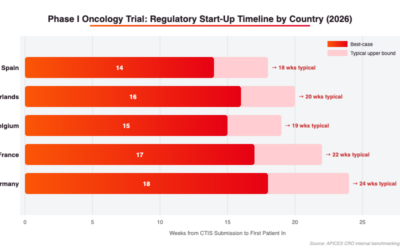
Importantly, Germany has introduced accelerated timelines for mono-national clinical studies. Applications can be assessed within 26 days after validation, with final approval granted within approximately 31 days when no deficiencies are identified.
These improvements significantly enhance Germany’s competitiveness for clinical trial start-up.
Clinical Trial Sites in Germany (Hospitals and Research Infrastructure)
Germany offers one of the most advanced clinical research infrastructures in Europe, supported by a strong network of university hospitals and specialized research centers.
Key characteristics include:
Extensive network of university hospitals (Universitätskliniken)
Highly experienced principal investigators
Strong academic and investigator-initiated research culture
Advanced infrastructure for early-phase and complex trials
Germany is particularly strong in conducting complex, high-science clinical trials requiring specialized expertise.
Patient Recruitment in Germany (Strengths and Challenges)
Germany provides access to a large patient population within a highly developed healthcare system.
Key advantages include:
Large and diverse population
High diagnostic standards and patient stratification
Strong integration between hospitals and research institutions
However, recruitment in Germany can be more controlled and slower compared to Southern or Eastern Europe. Strict inclusion criteria, competition for patients, and operational complexity can impact enrollment speed.
Sponsors should combine Germany with additional European countries in competitive indications to ensure recruitment targets are met.
Therapeutic Areas with Strong Clinical Trial Activity in Germany
Germany demonstrates strong clinical trial activity across multiple therapeutic areas, particularly those requiring scientific expertise.
Key areas include:
Oncology (strong academic networks and infrastructure)
Germany is frequently selected for trials requiring complex endpoints, biomarker-driven designs, and advanced methodologies.
Clinical Trial Start-Up Timelines in Germany (From Approval to First Patient In)
Operational timelines in Germany are generally longer than in some other European countries due to regulatory and contractual complexity.
Stage
Estimated Timeline
Regulatory and ethics approval
~60–70 days
Site selection and contracting
2–4 months
Site activation
3–5 months
First patient in (FPI)
4–6 months post-submission
Germany is best suited for sponsors prioritizing quality and scientific rigor alongside timelines.
Costs of Conducting Clinical Trial in Germany
Germany is considered a high-cost country for clinical studies in Europe.
Cost considerations include:
Higher investigator and site fees
Complex contracting processes
High operational standards increasing overall costs
However, these costs are often justified by high data quality, strong compliance, and reduced risk in complex studies.
When Germany Is the Right Choice for Clinical Trials
Germany is particularly well suited for:
Complex or scientifically demanding clinical trials
Early-phase and first-in-human studies
Studies requiring advanced infrastructure
Trials requiring high-quality data and regulatory rigor
Sponsors benefit from Germany’s strong scientific ecosystem and reliable study execution.
When Clinical Trials Require Additional Countries
Germany may not always deliver the fastest recruitment independently.
In multinational studies, sponsors should combine Germany with other European countries to balance recruitment speed and geographic reach.
A diversified country strategy ensures both quality and timely enrollment.
Advantages of Conducting Clinical Studies in Germany
Clinical research in Germany offers several strategic advantages:
High-quality regulatory oversight and scientific rigor
Access to leading academic investigators
Advanced clinical research infrastructure
Large and well-characterized patient population
Increasingly competitive timelines through regulatory improvements
These factors position Germany as a key country for high-quality clinical trials in Europe.
How APICES Supports Clinical Trials in Germany
APICES CRO supports sponsors conducting clinical studies in Germany through senior-led teams with strong understanding of the regulatory and operational landscape.
With experience delivering more than 450 clinical studies across Europe, APICES focuses on:
Realistic feasibility aligned with German site performance
Selection of high-performing clinical trial sites
Efficient regulatory strategy and study start-up
Close operational oversight ensuring consistent delivery
By combining local expertise with pan-European coverage, APICES enables sponsors to run clinical trials in Germany with greater predictability, quality, and control.
Frequently Asked Questions About Clinical Research in Germany
How long does it take to conduct clinical trials in Germany? Clinical trial approval typically takes around 60–70 days under CTIS, with faster timelines possible for mono-national studies.
Who regulates clinical trials in Germany? Clinical trials are regulated by BfArM or PEI, with ethical review conducted by Ethics Committees.
Can international sponsors run clinical trials in Germany? Yes, Germany is widely used by global pharmaceutical and biotechnology companies in multinational clinical trial programs.
Is Germany good for patient recruitment? Germany offers access to large patient populations, but recruitment may be slower compared to other European countries.
Which cities are best for clinical trials in Germany? Berlin, Munich, Heidelberg, and other major cities host leading clinical research centers.
Is Germany suitable for early-phase clinical trials? Yes, Germany is particularly strong in early-phase and complex trials due to advanced infrastructure and scientific expertise.
Frequently asked questions
Who reviews clinical trials in Germany — BfArM or PEI? Most small-molecule and many biologic trials are reviewed by BfArM (the federal authority). Trials involving advanced therapy medicinal products (ATMPs), vaccines, and certain biologics are reviewed by PEI (Paul-Ehrlich-Institut). Sponsors confirm the competent authority before submission.
How does the German ethics process work? Germany has multiple federal-state ethics committees. Under the EU CTR, sponsors select a coordinating ethics committee. In practice, central oncology and rare-disease sponsors often work with the ethics committees in Bavaria, North Rhine-Westphalia, or Berlin.
Why do sponsors choose Germany for oncology and rare-disease trials? Germany has Europe’s largest population and deep specialist site networks — especially in Heidelberg, Munich, Cologne, Hamburg, and Berlin. The cooperative groups (AIO, NOA, GMIHO) give access to high-quality oncology sites.
What is the typical start-up timeline in Germany? For an oncology Phase II trial, expect 5–7 months from final protocol to first-patient-in. Site contracting can be the slowest step — German hospital legal departments are thorough.
What are typical per-patient costs in Germany? For Phase II oncology, fees-per-patient typically run €20,000–€45,000, with overheads charged separately by hospital trial offices. Costs are higher than Spain or Italy but recruitment per site is also typically higher.
Get the latest clinical insights delivered to your feed or inbox!
Key Takeaways: First-in-human trials in the EU are governed by Regulation (EU) No 536/2014 and the EMA’s first-in-human guideline (EMEA/CHMP/SWP/28367/07 Rev 1). Sponsors must submit a complete Clinical Trial Application via the CTIS portal and obtain both Part I...
Key Takeaways: Phase I dose escalation design in the EU is governed by ICH E8(R1), EMA first-in-human guidance (EMA/CHMP/SWP/28367/07 Rev.1), and EU Clinical Trial Regulation 536/2014 via CTIS. The classical 3+3 design is increasingly replaced by model-based...
EU MDR clinical investigation requirements have fundamentally changed how Medtech sponsors plan and execute device studies in Europe. Regulation (EU) 2017/745 replaced the clinical investigation provisions of Directive 93/42/EEC (MDD) and introduced a more stringent, harmonised framework across all 27 EU member states. For sponsors running investigations in Spain, Germany, France, the Netherlands, or any other member state, understanding which pathway applies to their study is the single most consequential regulatory decision before CIP submission.