Clinical trials in the Netherlands are known for fast start-up timelines, efficient regulatory processes, and high-performing sites. This guide explains the approval process, infrastructure, and key advantages of clinical trials in the Netherlands.
Clinical Trials in the Netherlands: Approval Timelines, Regulatory Framework, and Why the Netherlands Is One of Europe’s Fastest Markets
The Netherlands is widely regarded as one of the most efficient countries in Europe for conducting clinical trials. Known for fast start-up timelines, highly organized clinical research infrastructure, and strong investigator engagement, the Netherlands plays a key role in early-phase and time-sensitive clinical development programs.
For sponsors planning clinical trials in Europe, the Netherlands offers a combination of speed, quality, and predictability that is difficult to match in larger markets.
Quick Facts
Metric
The Netherlands
Competent Authority
CCMO
Ethics Committees
MRECs
Approval Timeline
~50-60 days
Population
~18 million
Strengths
Oncology, rare diseases, neurology
Why Sponsors Choose the Netherlands for Clinical Research (Speed, Efficiency, Quality)
Sponsors choose to run clinical trials in the Netherlands because of its ability to deliver rapid study start-up without compromising quality.
Key advantages include:
Fast regulatory approval timelines under CTIS
Highly efficient ethics review processes
Strong investigator engagement and research culture
Concentrated network of high-performing clinical trial sites
High data quality and compliance standards
The Netherlands is often selected for studies where timelines are critical, including early-phase and proof-of-concept trials.
Regulatory Framework for Clinical Trials in the Netherlands (CTIS and CCMO)
Clinical trials in the Netherlands are conducted under the European Union Clinical Trials Regulation (EU No. 536/2014), with applications submitted via the Clinical Trials Information System (CTIS).
At the national level:
The Central Committee on Research Involving Human Subjects (CCMO) oversees clinical trial regulation
Accredited Medical Ethics Review Committees (MRECs) conduct ethical review
The Netherlands is known for a well-coordinated regulatory system with clear processes and efficient communication between authorities and sponsors.
Clinical Trial Approval Process in the Netherlands
Sponsors conducting clinical trials in the Netherlands must submit a complete application dossier via CTIS.
Required documentation includes:
Clinical study protocol
Investigator’s brochure
Investigational medicinal product dossier (IMPD)
Supporting safety documentation
The Netherlands benefits from a streamlined evaluation process, with efficient coordination between regulatory and ethics bodies.
Clinical Trial Approval Timeline in the Netherlands (Among the Fastest in Europe)
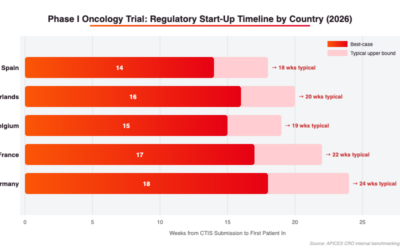
The Netherlands is consistently recognized as one of the fastest countries in Europe for clinical trial approvals.
Step
Estimated Timeline
CTIS submission
Day 0
Validation phase
~5–10 days
Scientific and ethical review
~40–50 days
Final authorization
~50–60 days
In practice, well-prepared submissions often move quickly through the system, supporting rapid study initiation.
Compact Geography and Its Impact on Clinical Trial Execution
One of the unique advantages of the Netherlands is its compact geography, which directly improves clinical trial operations.
Key benefits include:
Short travel distances between sites
Easier monitoring and site management
Faster patient access to clinical trial centers
Efficient coordination across multiple sites
This allows sponsors to manage multicenter trials with greater operational control and reduced logistical complexity.
Clinical Trial Sites in the Netherlands (High-Performance Centers)
The Netherlands has a concentrated network of highly experienced clinical trial sites.
Key characteristics include:
Strong university medical centers (UMCs)
Dedicated early-phase clinical trial units
High investigator expertise
Strong track record in multinational trials
Rather than relying on a large number of sites, the Netherlands focuses on high-performing centers capable of delivering consistent results.
Patient Recruitment in the Netherlands (Quality Over Volume)
The Netherlands offers access to well-characterized patient populations within a highly organized healthcare system.
Key advantages include:
High-quality patient data and registries
Strong patient engagement in clinical research
Efficient identification of eligible patients
While the total population is smaller than in countries like Spain or Italy, recruitment is often precise and efficient.
Sponsors typically combine the Netherlands with other countries when larger recruitment volumes are required.
Therapeutic Areas with Strong Clinical Trial Activity in the Netherlands
The Netherlands is particularly strong in:
Oncology (including early-phase and biomarker-driven trials)
Rare diseases
Neurology and CNS disorders
Advanced therapies (cell and gene therapy)
Infectious diseases
The country is frequently selected for studies requiring scientific precision and advanced methodologies.
Clinical Trial Start-Up Timelines in the Netherlands
Operational timelines in the Netherlands are among the fastest in Europe.
Stage
Estimated Timeline
Regulatory and ethics approval
~50–60 days
Site selection and contracting
1–2 months
Site activation
2–3 months
First patient in (FPI)
~3 months
The Netherlands is particularly well suited for sponsors aiming to minimize time to first patient in.
Costs of Conducting a Clinical Study in the Netherlands
The Netherlands is considered a mid-to-high cost country.
Cost considerations include:
Higher site and investigator costs
Efficient processes reducing overall timelines
High-quality data reducing downstream risks
Sponsors often accept higher costs due to the country’s speed and reliability.
When the Netherlands Is the Right Choice for Clinical Trials
Sponsors benefit from the Netherlands’ ability to deliver both speed and quality.
When a Clinical Trial in the Netherlands Require Additional Countries
Due to its relatively small population, the Netherlands may not be sufficient for large-scale recruitment alone.
Sponsors typically combine the Netherlands with other European countries to:
Increase patient recruitment
Expand geographic coverage
Maintain study timelines
This approach allows sponsors to leverage the Netherlands for speed while ensuring sufficient enrollment.
Advantages of Conducting Clinical Trials in the Netherlands
Clinical trials in the Netherlands offer several key advantages:
Fast regulatory approval timelines
Highly efficient clinical trial infrastructure
Strong investigator expertise
High-quality data and compliance
Excellent operational predictability
These factors position the Netherlands as one of the most efficient clinical trial markets in Europe.
How APICES Supports Clinical Trials in the Netherlands
Delivering clinical trials in the Netherlands requires a focused approach centered on site quality and operational precision.
APICES CRO supports sponsors by:
Identifying high-performing sites with proven delivery track records
Designing feasibility based on realistic recruitment scenarios
Optimizing start-up timelines through efficient coordination
Maintaining close oversight to ensure consistent study execution
This approach enables sponsors to fully leverage the Netherlands’ strengths in speed and efficiency.
Frequently Asked Questions About Clinical Research in the Netherlands
How long does it take to get approval for a clinical trial in the Netherlands? Approval typically takes around 50–60 days under CTIS, making it one of the fastest countries in Europe.
Who regulates clinical trials in the Netherlands? Clinical trials are overseen by CCMO, with ethical review conducted by accredited ethics committees.
Is the Netherlands suitable for early-phase clinical trials? Yes, the Netherlands is one of the leading countries in Europe for early-phase studies.
Is patient recruitment strong in the Netherlands? Recruitment is efficient and precise, though often complemented by other countries for larger studies.
What makes the Netherlands unique for clinical trials? Its speed, compact geography, and high-performing clinical sites.
Is the Netherlands a good country for oncology trials? Yes, particularly for early-phase and biomarker-driven oncology studies.
Frequently asked questions
How does CCMO review work in the Netherlands? The CCMO (Central Committee on Research Involving Human Subjects) is the central authority for clinical-trial review. Under the EU CTR via CTIS, decisions typically arrive within 60 calendar days. The Netherlands is one of the fastest Western European countries for trial start-up.
Why is the Netherlands attractive for early-phase oncology? Excellent Phase I units (NKI in Amsterdam, Erasmus MC in Rotterdam, UMCU in Utrecht), high English fluency among investigators and patients, and a regulatory culture that rewards well-designed protocols. Often a top-3 country for first-patient-in.
Are there any quirks for sponsors to plan around? The Netherlands has detailed insurance and indemnity requirements that are different from neighboring countries. Plan for early review of sponsor insurance certificates and the PROEF agreement (Dutch model clinical-trial agreement) to keep contracting on track.
What is the typical start-up timeline? For Phase II oncology, plan 4–6 months from final protocol to first-patient-in. The Netherlands is consistently one of the fastest destinations in Western Europe.
What are typical per-patient costs? Fees-per-patient typically run €20,000–€40,000 for Phase II oncology. Costs are competitive with Germany.
Get the latest clinical insights delivered to your feed or inbox!
Key Takeaways: First-in-human trials in the EU are governed by Regulation (EU) No 536/2014 and the EMA’s first-in-human guideline (EMEA/CHMP/SWP/28367/07 Rev 1). Sponsors must submit a complete Clinical Trial Application via the CTIS portal and obtain both Part I...
Key Takeaways: Phase I dose escalation design in the EU is governed by ICH E8(R1), EMA first-in-human guidance (EMA/CHMP/SWP/28367/07 Rev.1), and EU Clinical Trial Regulation 536/2014 via CTIS. The classical 3+3 design is increasingly replaced by model-based...
EU MDR clinical investigation requirements have fundamentally changed how Medtech sponsors plan and execute device studies in Europe. Regulation (EU) 2017/745 replaced the clinical investigation provisions of Directive 93/42/EEC (MDD) and introduced a more stringent, harmonised framework across all 27 EU member states. For sponsors running investigations in Spain, Germany, France, the Netherlands, or any other member state, understanding which pathway applies to their study is the single most consequential regulatory decision before CIP submission.