Western vs Eastern Europe for Clinical Trials: How CTIS Is Reshaping Country Selection
This article explores how Western and Eastern Europe compare as clinical trial destinations, and how CTIS is reshaping country selection. It reviews differences in regulatory processes, recruitment dynamics, site infrastructure, and costs, while highlighting a shift toward operational performance, patient access, and therapeutic expertise.
Eastern vs Western Europe for Clinical Trials
By Egle Pavyde, PhD, VP Business Development
Europe is not one clinical-trial “country”. It is a portfolio of ecosystems operating under a shared legal framework, with meaningful differences in speed, feasibility, patient access, cost, and operational friction. For Pharma and Biotech decision makers, the practical question is rarely “Western or Eastern Europe for clinical trials?” but rather:
Which mix of countries de-risks enrollment and timelines?
Where do we get the best probability-adjusted start-up speed and data reliability for the indication?
How do we build a portfolio that still works under CTIS/CTR transparency, fixed timelines, and multi-country coordination?
In this article you will find a structured, data-backed comparison, with a specific focus on what changed after CTR (Regulation (EU) No 536/2014) and the Clinical Trials Information System (CTIS) went live.
The baseline reality: Europe’s trial gravity is shifting and consolidating
Global country utilization has become more concentrated over the last five years.
The analysis of industry-sponsored interventional trials shows that Western Europe’s share of global “country-uses” fell from 32% (2019) to 25% (2023), and Central/Eastern Europe fell from 17% to 11% over the same period.
At the same time, industry voices have been blunt about Europe’s competitiveness: reporting on EFPIA findings, the Financial Times highlighted that Europe’s share of global commercial trials dropped materially over the last decade, alongside concerns about fragmented operations and slower timelines, with Spain called out as an exception due to ecosystem investment and simplification.
So what are the implications for sponsors? Europe is still essential for market access, diversity, and scientific leadership, but country selection inside Europe is becoming more “portfolio science” than tradition. Western and Eastern Europe play different roles in that portfolio.
What changed after CTIS/CTR came into force
The key policy milestones included:
31 Jan 2022: CTR became applicable and CTIS launched, replacing the Directive framework for new trials.
31 Jan 2023: CTIS became the single entry point for new clinical trial applications under CTR.
30 Jan 2025: end of transition; all ongoing CTD trials had to transition to CTR/CTIS.
What CTR/CTIS actually changes for sponsors:
One submission, coordinated multi-country assessment. Sponsors submit one dossier through CTIS for EU/EEA countries, with a coordinated assessment approach (Part I scientific/technical + Part II national/ethics/local feasibility).
Fixed, enforceable timelines (but clock-stops still exist). CTR codifies defined timelines for assessment, including Part I/Part II processes and structured RFIs/clock-stops. In the Regulation text (Eur-Lex), Part II assessment completion expectations are explicitly time-bound (e.g., “within 45 days from validation date” in relevant provisions).
Transparency becomes default. CTIS includes a public portal and updated transparency rules (with an updated portal release in 2024 and ongoing actions under ACT EU).
System-level analytics finally become possible. Because submissions and oversight flow through one system, Europe can publish EU-level operational insights. For example, the EU/ACT EU transition-period report quantifies volumes, mix (mono-national vs multinational), and country distributions.
The adoption signal: CTIS volume is now large enough to be “real world”
During the 3-year transition period, sponsors submitted 10,608 initial clinical trial applications in CTIS (including new, transitioned, and resubmitted), and between 31 Jan 2023 and 30 Jan 2025 the system averaged ~200 new initial applications per month.
This means that CTIS is no longer a “pilot reality”. It is the operating system, so Western vs Eastern Europe must be evaluated under the same submission mechanics, but different local execution realities.
Trial activity: which countries are absorbing volume under CTIS
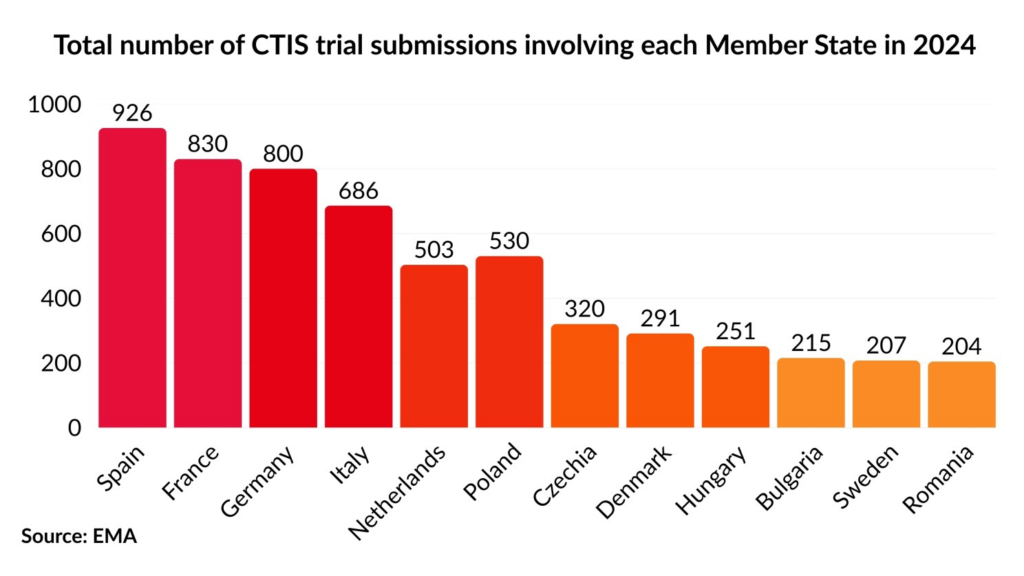
From the EU/ACT EU report on the CTR transition period, the total number of CTIS trial submissions involving each Member State in2024 shows a clear concentration on Spain, France, Germany and Italy.
If we group countries by Western/Nordic/Southern vs Central & Eastern Europe (CEE) (e.g., Poland, Czechia, Hungary, Romania, Bulgaria, Baltics, Slovakia, Slovenia, Croatia), then the regional trend is very clear:
Western/Nordic/Southern group around 5,600 trials in 2024 (~76%)
CEE group around 1,800 trials in 2024 (~24%)
Western Europe still captures the majority of “involvement volume,” but CEE remains a material share and often over-indexes in certain phases/therapeutic areas where recruitment speed is critical.
The operational comparison that actually matters
Start-up and regulatory throughput: “same portal, different lived experience”
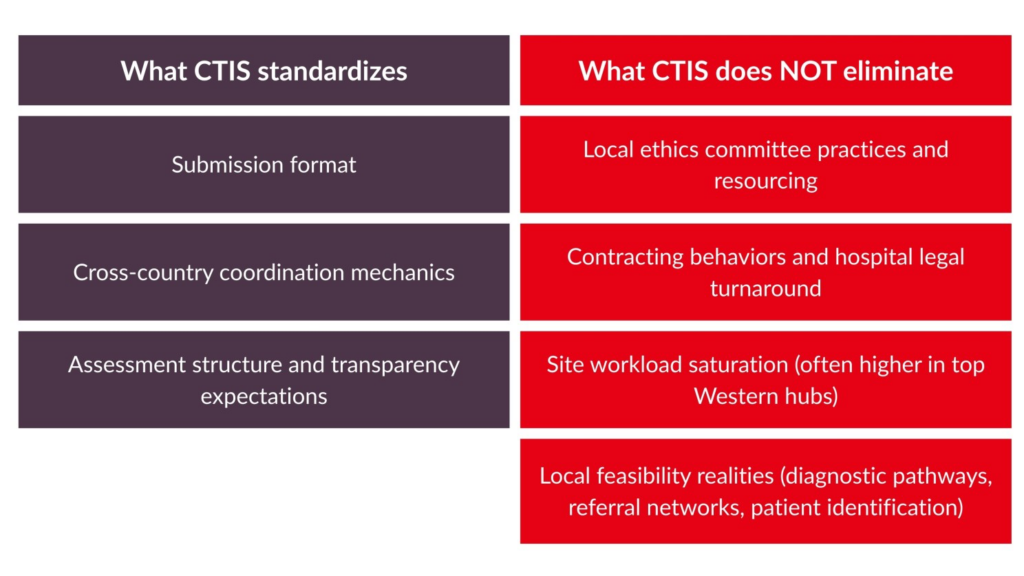
It is important to understand what CTIS standardizes and what CTIS does not eliminate:
Having this in mind the key takeaway for the Sposors should be that under CTIS, regulatory submission is more uniform, but the “critical path” often shifts to country-specific execution – especially contracting and site activation.
Recruitment and enrollment velocity: CEE’s strategic edge with nuance
EFPIA’s ecosystem assessment notes substantial variation across EEA countries and explicitly highlights Poland, Spain and Denmark as showing fast recruitment rates (i.e., not purely “East vs West,” but “ecosystem maturity + patient access + execution”).
Why CEE frequently performs well for enrollment in practice (generalizable mechanisms):
Larger pools of eligible patients concentrated in fewer centers
More centralized care pathways in some systems
Lower competing trial density in certain indications (not universal – oncology hubs can be saturated anywhere)
But the nuance is important – Western Europe can outperform when you need:
Faster access to novel diagnostics and biomarker infrastructure at scale
Deep experience with complex protocol procedures and high monitoring intensity
Cost and “probability-adjusted cost”: where simplistic comparisons break
It’s widely accepted in the industry that Western Europe is typically more expensive than CEE on site costs and operational expenses, but published numbers often come from heterogeneous, vendor-specific datasets. For strategic decisions, the bigger concept is:
Probability-adjusted cost = (cost per enrolled patient) × (risk of missing enrollment timelines)
CEE can be cost-advantageous and reduce enrollment risk, which can dominate total program economics (especially Phase II/III). Western Europe may have higher per-patient costs but can significantly reduce risk in:
Complex protocol execution
Advanced standard-of-care comparators
High-quality data capture in specialized academic networks
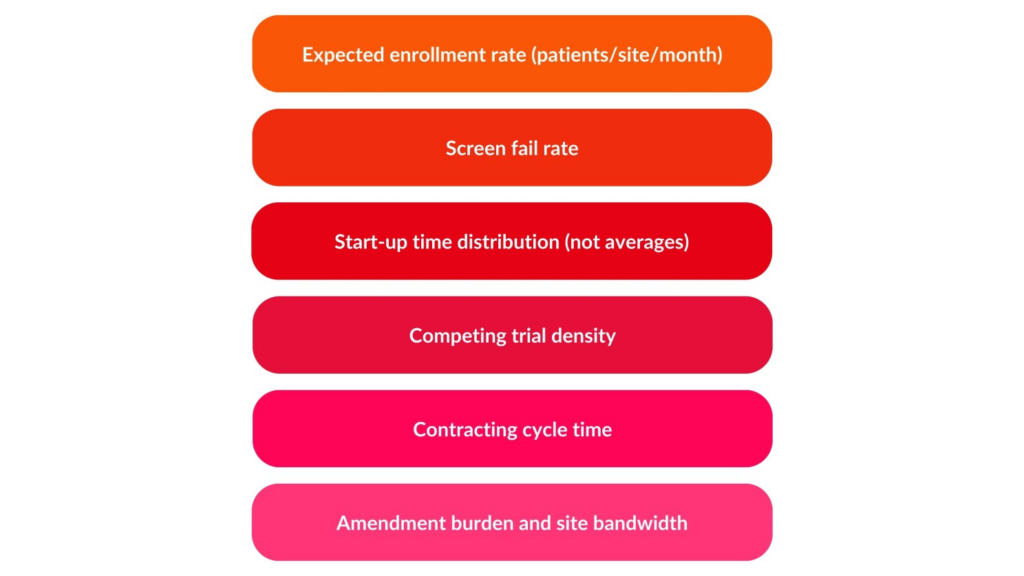
If you want a defensible, sponsor-grade model, consider building a country scorecard using the following elements:
How CTIS changes the Western vs Eastern Europe trend for clinical trials
Multi-country design becomes easier to justify
CTIS reduces the “paperwork penalty” of adding countries from a submission standpoint, which makes portfolio enrollment strategies more attractive: e.g., anchor Western Europe for KOL credibility + diagnostics, and add CEE to stabilize enrollment velocity.
Transparency shifts sponsor behaviour, especially for competitive Biotechs
CTIS transparency rules and the public portal mean that more data becomes discoverable by competitors, patients, and investigators over time. Also, Sponsors must be sharper about redaction strategy, document hygiene, and disclosure timelines.
This matters for country choice because some ecosystems are more mature in handling transparency logistics (templates, processes, institutional familiarity), while others may require more sponsor-side operational support.
Europe-wide analytics pushes evidence-based country selection
The EU/ACT EU reporting structure (e.g., submissions by country and year; mono-national vs multinational split) enables better benchmarking and internal learning loops. For example:
Across the transition period, 58% of initial applications were mono-national and 42% multinational.
That split is telling that despite CTIS enabling multi-country, many sponsors still choose mono-national designs, often because operational complexity (contracts, sites, logistics) still dominates over regulatory submission complexity.
A decision-grade framework for sponsors: when to prioritize Western vs Eastern Europe for clinical trials
Prioritize Western/Southern Europe when you need:
Centers of excellence for complex procedures, advanced diagnostics, or cutting-edge modalities
Strong academic credibility and publication pathways
High probability of meeting stringent quality expectations for complex endpoints
Dense networks for rare subtypes in oncology/neurology with biomarker stratification
Consider adding CEE (and the Baltics/CEE blend) to the mix when you need:
Enrollment acceleration for common-to-moderately-rare indications
More predictable patient access and often fewer competing trials (indication-dependent)
Strong Phase II/III execution in established research centers
Attractive probability-adjusted economics when timeline risk is high
CTIS makes this architecture easier to operate, but not automatic. You still need country-by-country feasibility with realistic competing-trial assumptions, contracting acceleration tactics (master agreements, standardized budgets, internal playbooks) and an operational owner for CTIS transparency and lifecycle submissions.
What sophisticated sponsors should do next
Stop treating “Western vs Eastern Europe” as a binary. Treat Europe as a portfolio: credibility + complexity handling + enrollment velocity + cost + risk.
Use CTIS-era metrics in governance. Track submission-to-decision times, RFI cycles, and amendment burden centrally. CTIS makes this measurable.
Benchmark against CTIS country volumes (and your own performance). Spain/France/Germany/Italy/Poland stand out in 2024 involvement volumes – use that as a “capacity + experience” signal, then validate indication-specific feasibility.
Build a probability-adjusted cost model. Your best country mix is the one that minimizes expected time-to-enrollment-close, not the one with the lowest line-item site costs.
In summary, the question of Western versus Eastern Europe for clinical trials has fundamentally shifted from a binary choice to a strategic portfolio decision. The introduction of the Clinical Trials Regulation and CTIS has standardized submission pathways, enforced greater transparency, and improved predictability at the regulatory level, but it has not erased the structural differences that define how trials are actually executed across Europe.
Western European countries continue to anchor scientific credibility, advanced diagnostics, and highly specialized clinical expertise, while Eastern and Central European countries remain critical for enrollment efficiency, operational agility, and timeline resilience. For Pharma and Biotech decision makers, competitive advantage in the post-CTIS era will come not from where trials can be submitted, but from where they can be delivered with the highest probability of success.
Planning clinical trials in Europe? Let’s chat! Contact our business development team and schedule a call to know how APICES CRO handles the acceleration of study timelines and generation of valuable data according to plan.
Get the latest clinical insights delivered to your feed or inbox!
Key Takeaways: First-in-human trials in the EU are governed by Regulation (EU) No 536/2014 and the EMA’s first-in-human guideline (EMEA/CHMP/SWP/28367/07 Rev 1). Sponsors must submit a complete Clinical Trial Application via the CTIS portal and obtain both Part I...
Key Takeaways: Phase I dose escalation design in the EU is governed by ICH E8(R1), EMA first-in-human guidance (EMA/CHMP/SWP/28367/07 Rev.1), and EU Clinical Trial Regulation 536/2014 via CTIS. The classical 3+3 design is increasingly replaced by model-based...
EU MDR clinical investigation requirements have fundamentally changed how Medtech sponsors plan and execute device studies in Europe. Regulation (EU) 2017/745 replaced the clinical investigation provisions of Directive 93/42/EEC (MDD) and introduced a more stringent, harmonised framework across all 27 EU member states. For sponsors running investigations in Spain, Germany, France, the Netherlands, or any other member state, understanding which pathway applies to their study is the single most consequential regulatory decision before CIP submission.